Living Out Our Calling in a Hostile World (1 Peter 3–5)
In Part III of our four-part journey through the Epistles of Peter, we explore how believers can respond to opposition with courage, love, and humility — turning suffering into a compelling testimony of hope in Christ.

See also:
Part I - A Letter from the Rock: An Introduction to the Epistles of Peter
Part II - A Living Hope for Alien Times (1 Peter 1 & 2)
Introduction
When life feels unfair…
When doing right leads to criticism…
When faith seems costly…
How do we keep going?
Peter has already reminded believers of their identity — chosen, holy, redeemed, anchored in a living hope that suffering cannot steal. Now he answers the next question:
How should God’s people live in a world that doesn’t always welcome our faith?
In 1 Peter 3–5, Peter moves from who we are to how we live. And he applies this truth right where it’s most tested — in our closest relationships, in community, and when we are under fire. These chapters are not theoretical. They teach us how to live beautifully, courageously, and faithfully in a culture that may not welcome us.
Part I: Christlike Relationships: Witness in the Everyday (1 Peter 3:1–12)
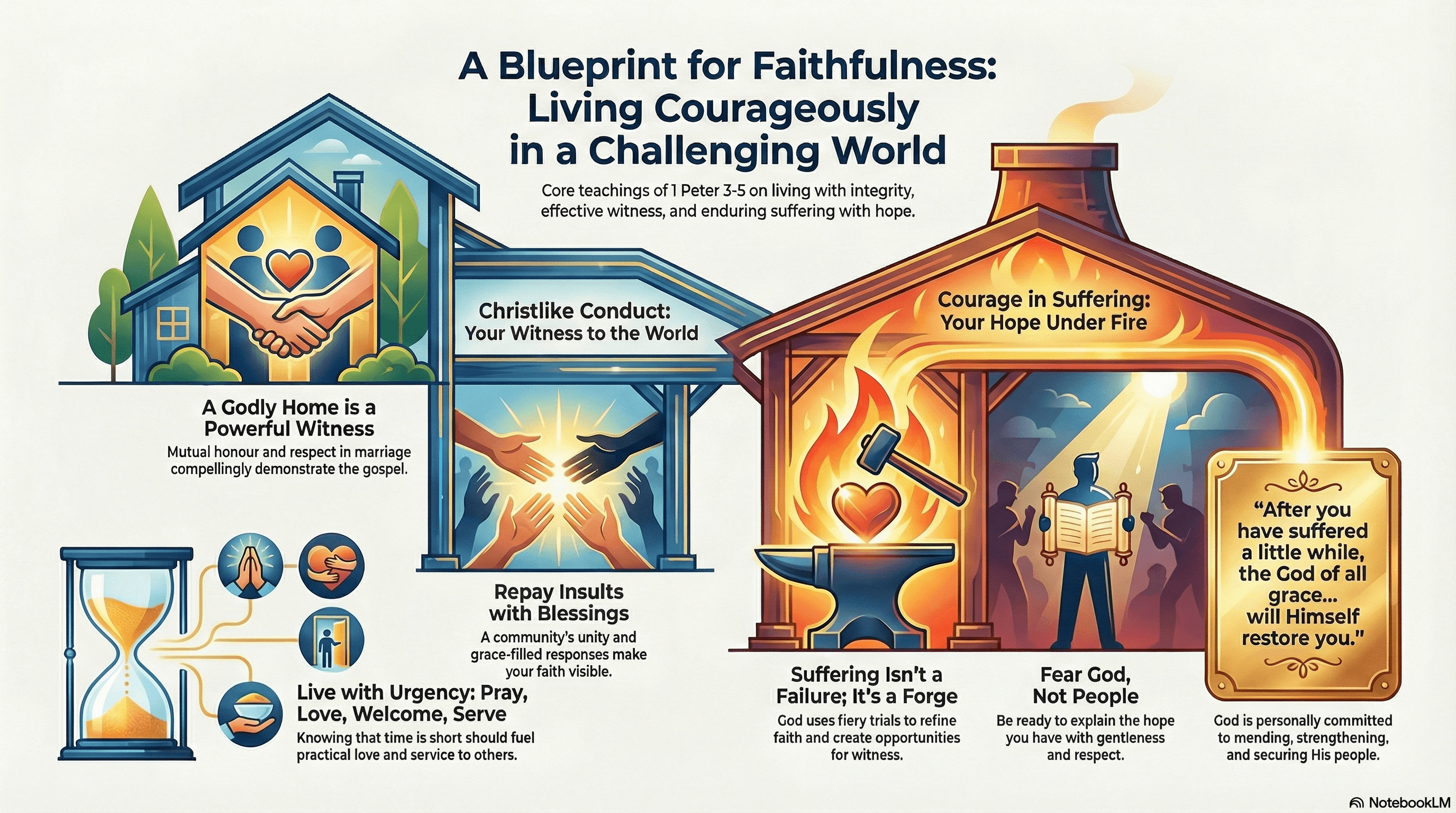
LIVING OUT OUR FAITH IN THE HOME (1 PETER 3:1-7)
Christianity is not a stage performance — it must be most authentic in the relationships where we are truly known. Peter begins where life is most vulnerable: the home.
The Heart of a Godly Wife: A Witness Without Words
Peter instructs wives to “submit yourselves to your own husbands” (1 Peter 3:1).
This is not a call for women to be lesser or silent. Peter is careful to specify that this command is to a wife's own husband, not to all men in general.
Why does this matter?
Because this submission reflects something beautiful:
the relationship between Christ and His Church — trustingly ordered, willing, and grounded in hope in God.
Just as Jesus was subject to His parents and to God the Father without being of lesser importance or dignity, so a wife's submission is consistent with her equal standing in Christ.
And there’s a powerful purpose behind it:
Instead of trying to persuade through arguments, nagging or pressure, a wife’s pure and reverent conduct can become the most compelling witness to a husband who does not believe (1 Peter 3:1–2).
A changed life speaks louder than well-crafted words.
Peter then deconstructs the world's idea of beauty, contrasting outward adornment—elaborate hairstyles, gold jewelry, and fine clothes—with what God considers truly beautiful:
“the imperishable beauty of a gentle and quiet spirit,
which in God's sight is very precious” - 1 Peter 3:4
“Gentle” ("meek”) — not weakness, but strength under control, rooted in trust.
“Quiet” ("tranquil”) — not silent, inner calm & peace that comes from God.
This kind of fearless faith is not driven by insecurity, cultural pressure, or comparison. It is a confidence that God sees, protects, and rewards those who trust Him.
That quiet strength becomes a testimony no one can ignore.
The Heart of a Godly Husband: A Considerate Honor
Peter then gives husbands an equally weighty call. Husbands are called to:
- Live with their wives in an understanding way
Be attentive, considerate, and gentle, having knowledge of his wife's weaknesses (such as physical weakness or vulnerability to temptation) and treating her with respect in spite of them (1 Peter 3:7). Seek to truly know and care for her needs — not dismiss them. - Show honor as to a fellow heir of God’s grace
She shares the same spiritual status and eternal inheritance in Christ. Treat her with the dignity that reflects that truth.
This isn’t merely good relational practice — Peter attaches a serious spiritual consequence:
A husband’s treatment of his wife affects his relationship with God.
If a husband chooses selfishness, harshness, or neglect, even his prayers can be hindered. Broken fellowship with his wife disrupts fellowship with God.
To honor your wife is to honor the God who made her.
To disregard her is to disregard the God who loves her.
A marriage patterned after Christ’s love becomes one of the clearest testimonies of the gospel in everyday life.
THE RADICAL CHRISTIAN COMMUNITY (1 PETER 3:8-12)
After addressing the home, Peter widens the lens to the entire church. He outlines five attitudes necessary for unity and a powerful collective witness (1 Peter 3:8):
- Be like-minded: Strive for unity in purpose and spirit.
- Be sympathetic: This goes beyond simple pity; it means to truly understand and care for what others are experiencing, as Paul says, "rejoicing with those who rejoice and mourning with those who mourn" (Romans 12:15)
- Love one another: This is a call for loyal, committed love, which Jesus identified as the primary hallmark of his disciples.
- Be compassionate: Move beyond feeling to action, showing kindness and forgiveness.
- Be humble: Adopt a servant's heart, putting others first, following the ultimate example of Jesus Christ.
These attitudes protect the fragile unity of the church and demonstrate the character of Christ to the world.
Then Peter gives a command that challenges our natural instinct:
"Do not repay evil for evil or reviling for reviling, but on the contrary, bless" (1 Peter 3:9)
Retaliation may feel justified, but grace is our calling.
God blesses those who choose to bless others — even when they hurt us.
When believers respond to hostility with kindness, forgiveness, and blessing…
the gospel becomes visible.
Where is God inviting you to show Christlike love — even when it’s hard?
How are you being called to bless someone who has wronged you?
Part II: Facing Suffering with Hope (1 Peter 3:13–4:19)
Most people see suffering as failure, interruption, or something to escape.
Peter teaches believers to see it differently.
Suffering can be…
an unexpected source of divine blessing
a crucible for purifying our faith
an unparalleled opportunity for a powerful witness to the hope that lies within us.
HOW TO RESPOND WHEN WE SUFFER FOR DOING GOOD
Peter gives five practical principles:
- Don't Be Surprised
Fiery trials should not catch us off guard. They are a standard part of the Christian experience (1 Peter 4:12). Like fire refining gold, testing proves what is genuine. - Rejoice
Suffering for righteousness is a sign we belong to Christ (1 Peter 4:13-14). It is evidence that His Spirit is at work in us. - Fear God, Not Man
Our confidence comes from God’s sovereignty, not human approval (1 Peter 3:14). When we reverence Him, the threats of others lose their power. - Be Ready to Explain Your Hope
A fearless, joyful life in suffering is profoundly counter-cultural and raises curiosity (1 Peter 3:15). We witness most powerfully through our response. - Entrust Your Soul to God
In the midst of suffering, the ultimate act of faith is to commit our souls to our "faithful Creator" (1 Peter 4:19). The Greek word for "entrust" is like making a safe deposit; it's a sacred act of leaving your most valuable possession with a trusted friend. Choosing to keep doing good — even in pain — declares that God is faithful.
Suffering may feel like a threat — but Peter calls it evidence of God at work.
It refines our character.
It clarifies our priorities.
It reveals where our hope truly rests
JESUS — OUR PATTERN AND OUR VICTORY
Peter continually points us to Christ Himself:
Jesus endured unjust suffering for a glorious purpose — to bring us to God.
Our trials, too, can have God-shaped purpose in our lives and in the lives of those watching us.
A proper understanding of suffering and victory should radically change how we approach our daily lives, which Peter addresses next.
“Beloved, do not be surprised at the fiery trial when it comes upon you to test you,as though something strange were happening to you.
But rejoice insofar as you share Christ's sufferings, that you may also rejoice and be glad when his glory is revealed.” (1 Peter 4:12-13)
Where do I need to entrust my fears to Jesus again?
Part III: Living with Urgency (1 Peter 4)
YOUR ATTITUDE ISN'T JUST A MINDSET; IT'S A WEAPON
In Chapter 4, Peter shifts from endurance to spiritual offense. His opening command:
"arm yourselves"
This is military language.
Christians are not passive victims of circumstance — we are active soldiers in a spiritual battle.
Jesus understood that suffering was part of His calling, so He faced it:
- Without sin
- Without retaliation
- Entrusting Himself fully to the Father.
Adopting His mindset prepares us to face hardship with courage and even joy.
Our attitude becomes a weapon and is the key to facing trials with courage and even joy.
Peter then makes a startling statement:
"whoever suffers in the body is done with sin."
He does not mean we become sinless.
Rather, suffering has a way of:
- weakening temptation’s pull
- exposing misplaced desires
- redirecting our hearts toward God’s will
Trials loosen our grip on old patterns. They refine our loyalty.
EXPECT REACTIONS
A changed life will be noticed. Peter anticipates two responses when believers stop following their old ways:
- Surprised — Unbelievers will be taken aback when Christians no longer participate in the "flood of debauchery" that characterized their former lives.
- Slander — Some may respond with mockery or pressure, as they malign believers for refusing to "join them" in their sinful ways.
Suffering what we truly treasure — Christ or comfort.
LIVING IN LIGHT OF "THE END OF ALL THINGS"
With this focus, Peter makes a crucial statement: "The end of all things is near" (1 Peter 4:7).
This is not fear-mongering. It is perspective.
It reminds us that our time to love, serve, forgive, and witness is short.
It is an encouragement that our present trials are temporary and God's glorious promises will soon be fulfilled.
In light of this reality, Peter gives four practical commands:
- Be Alert and Sober-Minded for Prayer
We are to be clear-headed and self-controlled, not "intoxicated" by worldly ambitions and distractions. This state of spiritual alertness is essential for effective prayer, which is our lifeline to God's power. - Love Each Other Deeply
Because "love covers over a multitude of sins."
Not enabling abuse, ignoring criminal acts, or sweeping destructive behavior under the rug... but
refusing resentment, choosing forgiveness
having "love focus" rather than a "sin focus"
resisting the urge to expose every fault
choosing relationship over retribution
"Hatred stirs up strife, but love covers all transgressions" (Proverbs 10:12) - Offer Hospitality Without Grumbling
In Peter's time, this often meant providing safe refuge for traveling or persecuted Christians. We are to open our homes and hearts cheerfully.
Hospitality is love you can see and feel. - Use Your Gifts to Serve Others
Every Christian has been given gifts as a "steward" of God's grace. Speak, serve, and strengthen others with the strength God provides — so He gets the glory.
A church that prays, loves, welcomes, and serves becomes a compelling witness — even to those skeptical of faith.
What gift has God given you that could strengthen someone else today?
Part IV: Standing Firm Together Under God’s Care (1 Peter 5)
Peter concludes his letter with a strong encouragement: stand firm.
We cannot do this alone. Faith flourishes in community — strengthened by humble leadership, shared dependence on God, and spiritual vigilance.
Peter reminds the church:
SHEPHERDS MUST LEAD LIKE JESUS
Church leaders are to shepherd God’s people:
- Willingly — not out of pressure
- Eagerly — motivated by love, not personal gain
- By example — influencing through character, not control
Christ Himself is the Chief Shepherd, and He will reward those who faithfully care for His flock.
EEVERYONE MUST CHOOSE HUMILITY
Humility is not weakness — it is the posture of those who trust God’s mighty hand. It is not about thinking of yourself less but thinking less of yourself less.
“Cast all your anxiety on Him because He cares for you.” (1 Peter 5:7)
We release our fears to Him because we are held by Him.
To humble ourselves is to rest under His care..
OPPOSITION IS REAL, BUT DEFEAT IS NOT
Peter then pivots to the reality of spiritual warfare. He reminds believers that their struggle is not ultimately against the people who persecute them. The real enemy of a Christian is "the devil," who prowls around seeking to devour (1 Peter 5:8)
So Peter commands:
- Be alert and of sober mind — stay spiritually awake and discerning, recognizing the constant threat.
- Resist him — stand firm in faith, not fear.
You are not alone — believers everywhere are in this same battle.
That shared courage strengthens us.
We resist together.
We endure together.
We stand firm together
Where do you need to stand firm — not alone, but with the church family?
The Final Promise: God Will Finish What He Started
Then Peter gives one of the most comforting promises in all Scripture:
“After you have suffered a little while,
the God of all grace…
will Himself restore,
confirm, strengthen and establish you.”
(1 Peter 5:10)
God Himself will:
- restore you. The Greek word also means "perfect." God will mend what was broken.
- replace our weakness & weariness with His divine strength
- plant us on unshakeable ground
- secure us forever
Suffering is temporary.
Glory is eternal.
And grace reigns in the end.
God is personally committed to your restoration.
Why This Matters Today
We live in a world of:
- constant outrage
- self-promotion
- relational fracture
- spiritual numbness
1 Peter calls us to a different way:
- honor over dominance
- blessing over retaliation
- courage over fear
- joy over despair
- community over isolation
This is not the easy way —
but it is the way of Jesus.
And it is the way that leads to life.
In what situations can blessing overcome bitterness?
Looking Ahead: Part 4 — 2 Peter
Peter closes his first letter by urging believers to stand firm.
But there is more he wants to say — especially about staying spiritually awake in a deceptive world.
In the final part of our series, we will explore his last recorded words before martyrdom:
a charge to guard the truth, grow in grace, and keep our eyes fixed on the promise of Christ’s return.
Stay tuned for: Part 4 — Guarding the Faith: A Call to Stability and Growth (2 Peter)
----
To help you engage with this teaching in the way that best suits you, the above content is available in three formats:
- Presentation Slides: PDF (Click link)
- Visual Summary
- Video
Living with Courage
Continue Reading
A Letter from the Rock: An Introduction to the Epistles of Peter
For believers walking through loss, opposition, discouragement, or uncertainty, Peter’s letters speak with a steady and compassionate voice of hope. He reminds us of our true identity as God’s own and anchors us in the living hope secured in Christ. This four-part series begins with an introduction, opening a gentle pathway into the themes and truths of 1 and 2 Peter.
For believers walking through loss, opposition, discouragement, or uncertainty, Peter’s letters speak with a steady and compassionate voice of hope. He reminds us of our true identity as God’s own and anchors us in the living hope secured in Christ. This four-part series begins with an introduction, opening a gentle pathway into the themes and truths of 1 and 2 Peter.

The Unbroken Thread: The Bible as One Unified Story
The Bible is often read in fragments—but it was written as one story. Across 66 books and more than 1,500 years, Scripture unfolds a single narrative of creation, brokenness, redemption, and hope. This teaching helps you see the Bible not as isolated passages, but as one coherent story that reveals God’s purpose for the world—and for us.
The Bible is often read in fragments—but it was written as one story. Across 66 books and more than 1,500 years, Scripture unfolds a single narrative of creation, brokenness, redemption, and hope. This teaching helps you see the Bible not as isolated passages, but as one coherent story that reveals God’s purpose for the world—and for us.

A Living Hope for Alien Times (1 Peter 1 & 2)
Part II in a four-part journey through the Epistles of Peter: In a world that often feels unfamiliar and costly to faith, Peter’s first letter reminds believers who they are, what they are called to, and how they are to live. Rooted in 1 Peter 1–2, this teaching explores our identity as God’s chosen people, our call to holy distinctiveness, and our witness as faithful exiles—anchored in a living hope that suffering cannot destroy.
Part II in a four-part journey through the Epistles of Peter: In a world that often feels unfamiliar and costly to faith, Peter’s first letter reminds believers who they are, what they are called to, and how they are to live. Rooted in 1 Peter 1–2, this teaching explores our identity as God’s chosen people, our call to holy distinctiveness, and our witness as faithful exiles—anchored in a living hope that suffering cannot destroy.